
Overcoming the Blank Page: Introducing Smart Defaults for Your DCF Valuation
Updated on 24 Feb 2026, 12:00

In our previous guide , we walked through the mechanics of setting up your first screener on the Value Sages platform. We explored how filtering by intrinsic value and user-defined assumptions can help you find the signal in the market's noise.
However, as we continuously analyze the behavioral data and sentiment of retail investors - particularly within the rigorous and analytically-minded European markets - we noticed a recurring point of friction.
Our initial valuation setup—both for the market screener and individual company analysis - suffered from a dual behavioral bottleneck: choice overload and its specific manifestation, blank page syndrome. First, the available inputs for critical metrics like growth and discount rates were unconstrained, practically allowing users to enter any value between 0 and 100%. Second, users were presented with a completely blank form of DCF input parameters, forcing them to generate these complex financial assumptions from scratch.
It is our internal hypothesis that this specific combination easily leads to decision paralysis and, ultimately, platform abandonment. By demanding such a high cognitive load upfront, this friction prevents the user from realizing the core value of the tool: quickly filtering the market or assessing a company based on solid fundamentals.
To understand this hypothesis, we look to the general definitions of these psychological concepts:
- Choice Overload and Decision Paralysis: According to behavioral science insights from The Decision Lab, choice overload occurs when individuals are presented with too many options or unconstrained variables, leading to decision fatigue and an inability to make any choice at all (decision paralysis).
- Blank Page Syndrome: This is a specific form of choice overload. When an individual faces a completely empty starting point - like a writer staring at a blank page or an investor staring at an empty DCF form - the lack of initial constraints or a baseline to react to triggers anxiety and cognitive freeze, making it incredibly difficult to initiate the task.
To solve this, we are thrilled to introduce Smart Defaults - a feature designed to reduce cognitive friction, utilize company-specific data at scale, and accelerate your path from screening to deep analysis.
The Psychology of Smart Defaults
Let me be clear: Value Sages does not spoon-feed you a "Fair Value." As an investor, your identity is built on independent thought and rigorous analysis. From a compliance and regulatory standpoint, automatically generating intrinsic values borders on providing financial advice - which we do not do.
Instead, Smart Defaults act as your decision architecture. Editing a pre-populated baseline is psychologically much easier than creating one from scratch. By providing logically sound, data-driven starting points, we make the setup easier to explain, grasp, and modify. You remain in the driver's seat; we just adjusted the mirrors and primed the engine.
How Smart Defaults Work in Your Screener
When you set up a screener or navigate to a company's Valuation tab, Value Sages will now leverage system-calculated values to populate the DCF fields. Here is the logic behind the baseline we provide:
1. FCF Growth Rate: Company-Specific or a 3% Floor
We utilize our robust algorithm to calculate the historical Free Cash Flow (FCF) growth rate for each individual company (you can read the deep dive on our methodology in our Growth Rates blog post). This allows you to screen the entire market using company-specific data rather than applying a blunt, constant growth rate across all equities.
The Default Floor: Financial data is messy. If a company has missing data, highly volatile FCF, or simply lacks the 5-year history required by our algorithm, the system defaults to 3%. Why? This mirrors the historical long-term inflation average. The baseline assumption is that a surviving business should, at the very least, grow its cash flows at the rate of inflation to maintain its real purchasing power.
2. Discount Rate: System WACC or an 8% Floor
The discount rate is your required rate of return. Value Sages automatically pulls the company's Weighted Average Cost of Capital (WACC) to use as this baseline (learn more in our Unlocking Precision: WACC blog post).
The Default Floor: We set a minimum default of 8%. Why? In certain macroeconomic environments, a company's calculated WACC might be artificially low (e.g., 4% or 5%). However, as an equity investor taking on market risk, setting a floor of 8% accounts for the opportunity cost of capital and aligns with reasonable, long-term equity portfolio growth expectations.
3. Margin of Safety: 15%
Benjamin Graham taught us that the Margin of Safety (MoS) is the secret to sound investing. We pre-populate this field with 15%. Why? A 15% buffer is a highly pragmatic starting point. It provides a meaningful shield against estimation errors in your growth or discount rate assumptions, while remaining realistic enough to actually uncover viable investment opportunities in today's market.
4. Terminal Value Multiplier: 15x
To calculate the terminal value of the business at the end of the projection period, we default to a multiplier of 15. Why? This roughly accounts for the long-term average Price-to-Earnings (P/E) ratio of the broader market. It assumes that upon reaching maturity, the company will trade at an average market valuation.
Putting It All Together
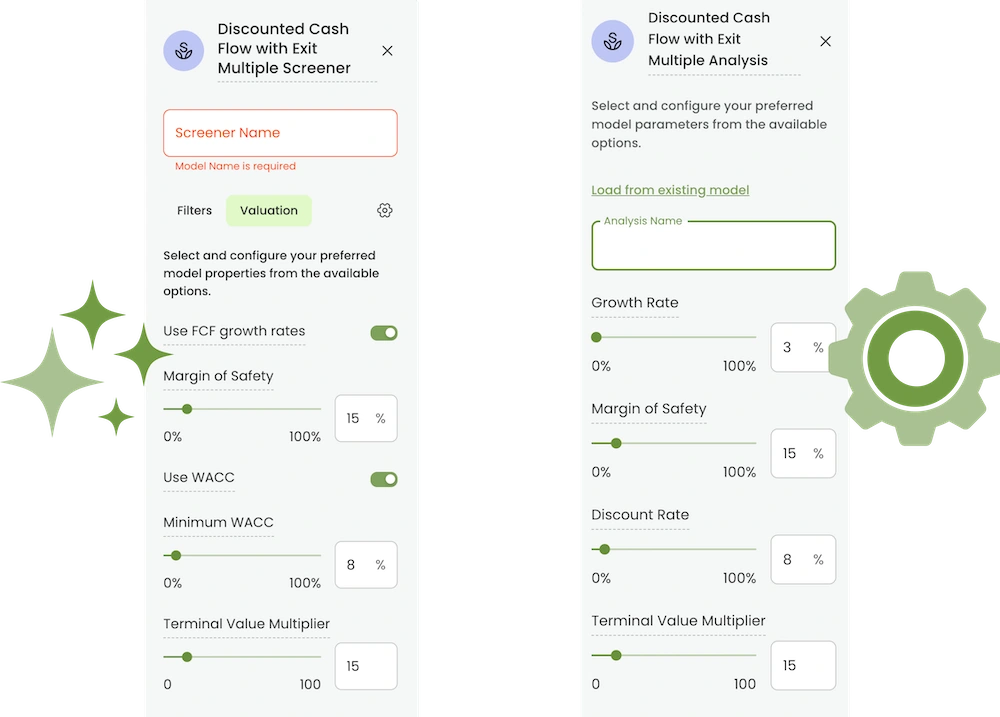
When you open the Valuation tab, you will immediately see these Smart Defaults in action. For example, if a company's actual growth rate cannot be reliably determined, you will see the FCF growth rate populated with 3, and if its WACC is unusually low, the discount rate will show 8 - alongside the 15% Margin of Safety and 15x Terminal Multiplier.
Crucially, this seamless experience extends beyond the screener. When you dive into a specific company's profile to create a dedicated DCF analysis, the interface pre-populates these exact same Smart Defaults. This shared approach acts as a springboard, dramatically easing the cognitive burden of setting up your models. Whether you are crafting an optimistic bull case, a pessimistic bear case, or evaluating a specific business development scenario, you start from a data-driven baseline rather than a blank page.
You can - and should - change these defaults to match your personal macroeconomic outlook, risk tolerance, and qualitative research. But if these baseline assumptions align with your expectations, setting up a rigorous, DCF-based market screen or individual company valuation now takes seconds instead of minutes.
By blending the power of company-specific financial data with smart, conservative baselines, we are giving you a more accurate and intuitive canvas to paint your investment thesis.
References: The Decision Lab: Choice Overload Bias, 5 Ways to Overcome Blank Page Syndrome

Analyze companies with transparency, confidence, and full control.
Try Value Sages Free Disclaimer - No Investment Advice
The content provided on this Website is for educational and informational purposes only. It does not constitute financial, investment, or legal advice. Users should conduct their own research and/or consult professional advisors before making any investment decisions. SAGES LTD is not responsible for any financial losses incurred based on the information provided.


