
From Isolation to Collaboration: Introduction to Shared Analysis
Updated on 01 Mar 2026, 12:00

Background: The Psychology of the 'Lone Wolf' Investor
Stock analysis has historically been a remarkably lonesome endeavor. The team at Value Sages can intimately relate to this. Most of us have spent countless hours in isolation, fiddling with Discounted Cash Flow (DCF) spreadsheets, analyzing a company's financials, and letting our carefully crafted assumptions gather dust in a forgotten desktop folder.
But beyond the mere inconvenience of manual tracking, there is a hidden psychological cost to this isolation. Behavioural finance tells us that when we make financial decisions in a vacuum, we are highly susceptible to cognitive biases. Without a sounding board, we could easily fall prey to confirmation bias (seeking only data that supports our initial thesis)[1] or loss aversion (making irrational choices out of fear of loss[2]).
Academic research strongly supports the psychological benefits of breaking this isolation. Foundational work in psychology demonstrates the power of accountability - when people know they must justify their assumptions to peers, they process their decision-making more systematically and are far less likely to rely on flawed cognitive heuristics[3]. Furthermore, recent empirical evidence from retail investing networks shows that structured social interaction directly mitigates specific, portfolio-damaging behaviors like the disposition effect - the irrational tendency to sell winning assets prematurely while holding onto losing ones.[4].
This is precisely why the Value Sages team originally came together. We began exchanging ideas and testing our investment hypotheses against one another, enriching our perspectives and tapping into the power of group wisdom.
Today, we are thrilled to announce our latest feature designed to bridge this gap and democratize fundamental value investing: Publicly Shared Analysis.
Introducing Publicly Shared Analysis
Any stock analysis you create in the Value Sages application can now be securely shared with the public or your private network. We designed this feature to foster intellectual debate, peer review, and financial education, all while keeping the conversation grounded in mathematical fundamentals rather than market noise.
Here is how different types of users can leverage this feature in a safe, compliant, and highly effective manner:
1. The Peer-Reviewer (Individual Investors)
Expose your hypothesis for the valuation of a stock to your trusted group of peers. By sharing your specific growth rates, discount rates, and margin of safety, you invite constructive critique. You can drop the link into your preferred off-platform community - whether that is a Discord server, a WhatsApp group, or a LinkedIn post - and use Value Sages as the centralized quantitative reference point for the ensuing discussion. This transforms a solitary guess into a rigorous intellectual debate, allowing you to identify blind spots in your thesis before risking capital.
2. The Academic & Educator
For university lecturers or financial literacy educators organizing courses on stock valuations, theory often struggles to meet practice. You can now share a live, interactive analysis with your students. You can assign them to interpret the assumptions, tweak the variables to see real-time impacts on intrinsic value, and submit their variations as coursework.
3. The Investment Club
For formal or informal investment clubs, shared analysis acts as the ultimate collaborative due diligence tool. Before the group votes on a thesis, the designated analyst can circulate the Value Sages link to their members' forum. This ensures every member understands the exact fundamental assumptions underpinning the pitch before the debate even begins.
How It Works: Mechanics & Privacy
Sharing your analysis is seamless and puts you entirely in control of your privacy and data distribution.
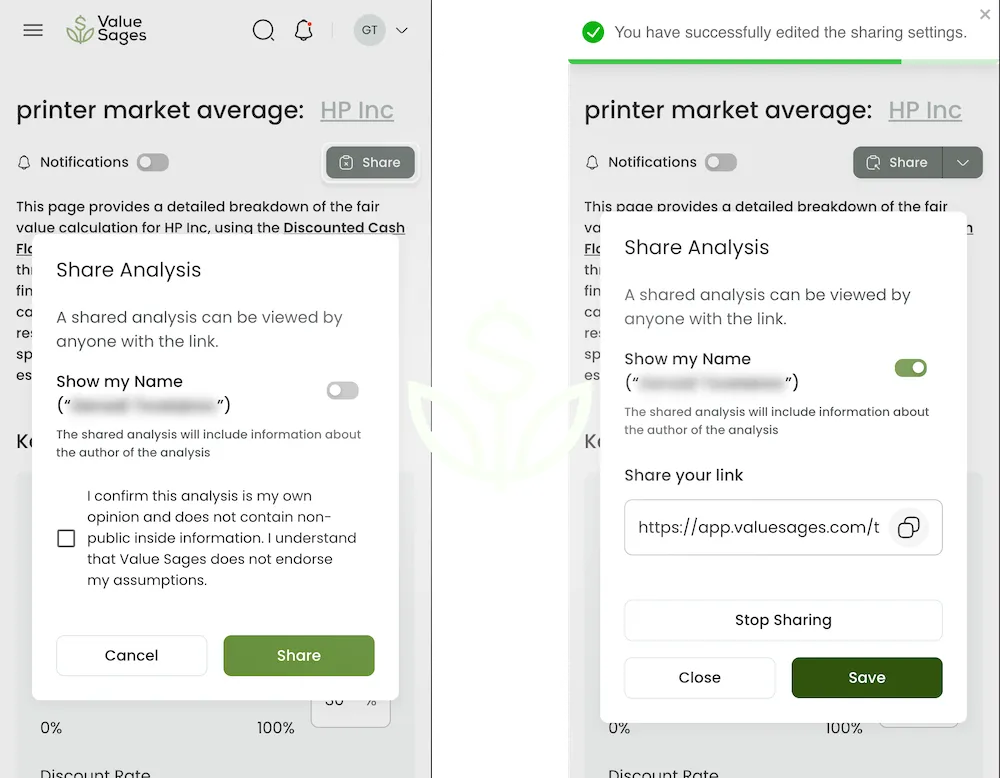
- Generate the Link: Navigate to the detailed view of any analysis you have created. Click the Share button to open the settings modal.
- Choose Your Identity: You can choose to display your username as the author, helping you build a reputation for rigorous analysis, or you can toggle to Anonymous to share your numbers without attaching your identity.
- Distribute: Once activated, copy the permanent link and share it with your community, students, or peers.
- Revoke Access Anytime: While the generated link does not have an expiration date, you remain in complete control. If you decide you no longer want your analysis to be public, you can simply disable sharing in the settings. The previously generated link will immediately become inactive and inaccessible.
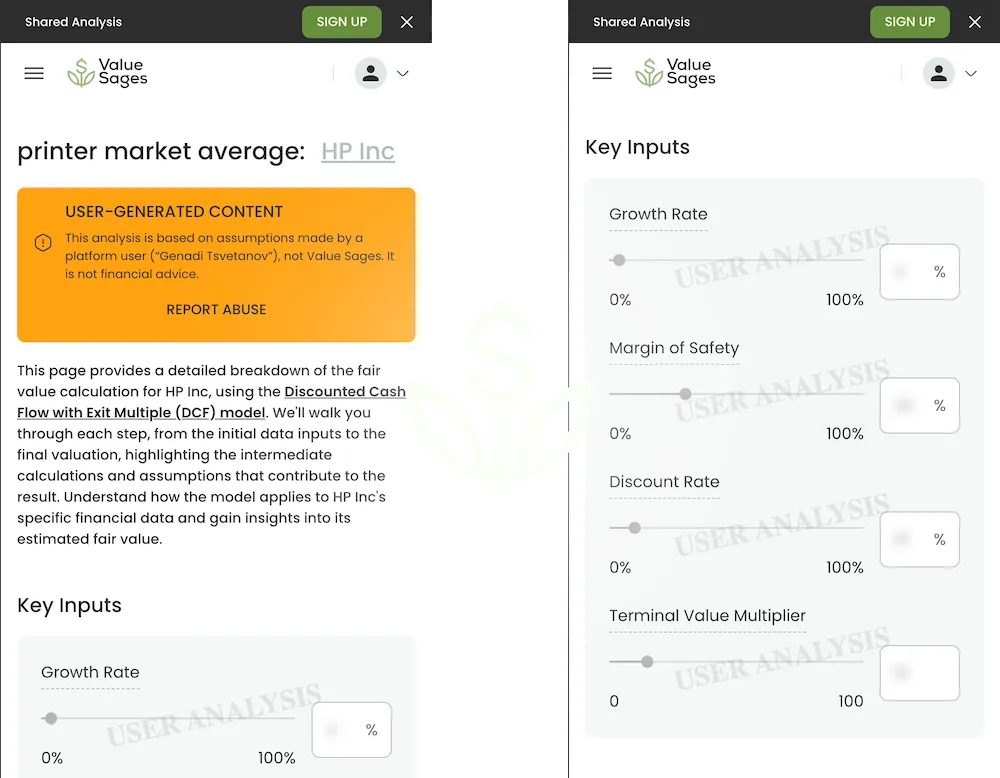
When a viewer opens your active link, the interface provides clear indications that the assumptions belong to a Value Sages user. To protect the integrity of the data, user-specified inputs are clearly watermarked, ensuring transparency about where the data originated.
Compliance and Viewer Protection: Keeping the Community Safe
At Value Sages, our north star is empowering investors through objective education. However, we are acutely aware of the regulatory landscape and the risks of market manipulation (such as 'pump and dump' schemes) prevalent on other social platforms.
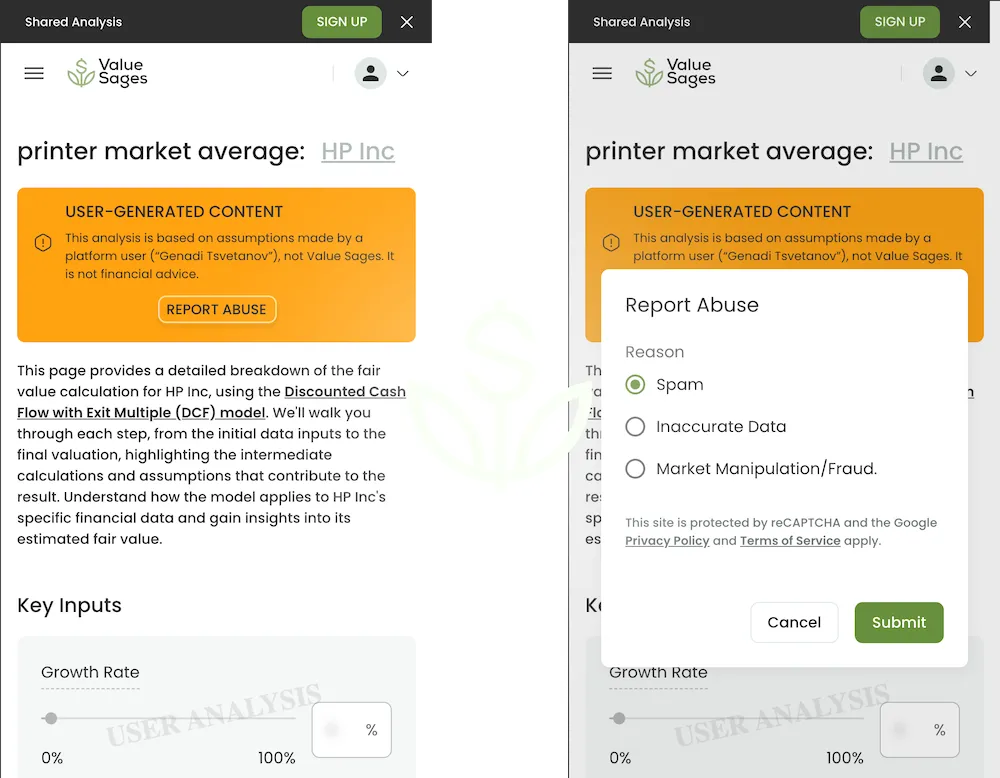
If someone's intentions do not align with educational knowledge-sharing, we have safeguards in place. If a viewer believes an analysis is being used to mislead, misrepresent information, or violate our community guidelines, they can immediately flag it using the “Report Abuse” button located at the top of the report. This triggers an internal review by our team and can lead to the immediate removal of the shared link.
Summary
Investing does not have to be a solitary endeavor fraught with unchecked biases and second-guessing. By bringing your DCF models out of the dark and into the light of peer review, you subject your ideas to the ultimate stress test. The Publicly Shared Analysis feature is our next step in building a toolbox that not only calculates numbers but cultivates smarter, calmer, and more collaborative investors.
Ready to test your thesis with the community? Log in to your Value Sages account, finalize your latest model, and click Share.
References: [1] Nickerson, R. S. (1998). "Confirmation Bias: A Ubiquitous Phenomenon in Many Guises." Review of General Psychology, 2(2), 175-220., [2] Kahneman, D., & Tversky, A. (1979). "Prospect Theory: An Analysis of Decision under Risk." Econometrica, 47(2), 263-291., [3] Lerner, J. S., & Tetlock, P. E. (1999). "Accounting for the effects of accountability." Psychological Bulletin, 125(2), 255–275., [4] Jin, X., Li, R., & Zhu, Y. (2021). "Could social interaction reduce the disposition effect? Evidence from retail investors in a directed social trading network." PLoS One, 16(2):e0246759.

Analyze companies with transparency, confidence, and full control.
Try Value Sages Free Disclaimer - No Investment Advice
The content provided on this Website is for educational and informational purposes only. It does not constitute financial, investment, or legal advice. Users should conduct their own research and/or consult professional advisors before making any investment decisions. SAGES LTD is not responsible for any financial losses incurred based on the information provided.


